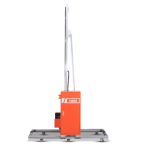
UV wall printing is already a mature commercial technology with an established global market, proven revenue potential, and several hundred thousand operating machines worldwide. But the technology is not static. The next 4–5 years will bring fundamental changes in how wall printers operate, how they connect to design workflows, and what kinds of output they can produce.
This article is a forward-looking analysis of where UV wall printing is heading — grounded in current technology trajectories, industry research, and the broader trends in AI and IoT integration visible across the wider printing and manufacturing sectors. For current market size context, see: Wall Printing Industry Trends 2026.
MARKET FORECAST: WHERE THE NUMBERS POINT |
Global wall printer market projected to grow at 7.7–15% CAGR through 2030. |
By 2030: 60% of professional wall printers expected to incorporate AI-driven calibration and IoT-enabled monitoring (industry research, 2025). |
Integration of automation features in UV systems reduces labour costs by up to 30%, improving ROI for operators. |
IoT integration will dominate R&D investment in the wall printing sector in 2026–2030 (UV printer market analysis, 2025). |
To understand where wall printing technology is heading, it helps to be precise about where it currently stands. Current Tudox models represent the state of the art in the value-quality tier of the market:
These capabilities are already commercially excellent. The question is what the next generation adds — and how quickly those capabilities reach the commercial market at accessible price points.
For a technical foundation on how current machines work: How Does a Wall Printing Machine Work? Complete Technical Guide.
Current machines use ultrasonic sensors for distance measurement. Next-generation systems integrate computer vision (CV) cameras and AI image processing to generate a complete 3D surface map before printing begins. This enables automatic detection of surface defects (bubbles, cracks, texture anomalies), automatic path planning that accounts for surface variation, and print head positioning corrections on a millimetre-by-millimetre basis rather than the averaging approach of current ultrasonic systems.
Impact: eliminates the most common cause of quality defects in current commercial operation; enables high-quality printing on surfaces that currently require manual technique adjustment (rough stone, complex textures, uneven renders).
Current ICC colour profile calibration is accurate but static — it requires manual calibration per surface type and does not adapt in real time to variation within a single wall surface. AI-driven colour management systems that are already emerging in high-end flatbed printers analyse the printed output live during the first few passes and automatically adjust ink density, colour channel balance, and curing intensity for the specific surface conditions encountered.
Impact: consistent colour accuracy across variable surfaces without operator intervention; significant reduction in test prints and calibration time; improved output quality on surfaces that currently require experienced technique to handle well.
AI design generation — the ability to generate commercial-quality wall art from a text or image prompt — will fundamentally change the design workflow for wall printing operators. Rather than requiring clients to provide print-ready artwork or engaging a graphic designer for every project, AI tools already capable of generating high-resolution images at mural quality will integrate directly with wall printer RIP software.
The commercial implication: operators can offer a full design-to-print service from a brief description — ‘tropical botanical mural in blue-green tones with the company logo’ — completing the entire workflow without external design involvement. This expands the accessible client base and increases per-project revenue for operators who develop the AI design workflow.
AI systems trained on print head usage patterns, ink consumption data, and historical failure records can predict when a print head is approaching end-of-life, when cleaning cycles need to increase, and when specific ink channels are showing early-stage clogging — before any quality degradation is visible to the operator. This shifts maintenance from reactive (respond to quality problems) to predictive (prevent them). For commercial operators, reduced downtime is direct revenue protection.
IoT (Internet of Things) integration connects wall printers to cloud management platforms, enabling capabilities that are operationally transformative for multi-machine or multi-operator businesses. The UV ink curing system already benefits from sensor-driven monitoring — future systems extend this to full operational transparency:
IoT Capability | What It Enables | Commercial Benefit |
|---|---|---|
Real-time machine monitoring | Remote visibility of print progress, machine status, error alerts | Operator can manage multiple simultaneous jobs across locations |
Ink level tracking | Automatic alerts when any channel approaches low; remote top-up scheduling | Eliminate on-site ink-out failures; optimise consumable ordering |
Job management dashboard | Queue, prioritise, and schedule print jobs remotely via mobile app | Efficient multi-site business operation without physical machine presence |
Performance analytics | Track m²/hr output, downtime frequency, maintenance intervals per machine | Business data for pricing, scheduling, and investment decisions |
Remote diagnostics | Technical team can access machine data remotely for troubleshooting | Faster resolution of technical issues; reduced support costs |
Environmental monitoring | Sensors track temperature and humidity at the print location | Automatic alerts when conditions fall outside optimal parameters |
The business model implication of full IoT integration: a single operator can manage a fleet of machines operating across multiple simultaneous sites — receiving real-time status updates, monitoring quality remotely, and coordinating ink supply across an entire operation from a mobile dashboard. This is already achievable with current technology in the premium tier; it will become standard-equipment across all tiers by 2028–2030.
Current operational speeds of 2–6 m²/hr are commercially viable but represent a limiting factor for large-scale projects. The print speed evolution is closely linked to print head generation advances.
Two trajectories are converging to increase throughput significantly:
The projected result: 10–15 m²/hr operational speeds at current quality levels within 4–5 years. This changes the project economics for large-scale commercial installations — a 100 m² hotel lobby mural that currently requires 2 operational sessions becomes a single-day project.
Multi-pass UV printing with progressively thicker varnish layers can already create raised, tactile print effects on flat surfaces. Current machines achieve this in limited configurations; next-generation systems with dedicated varnish channels and AI thickness control will deliver commercially viable embossed and textured printing as a standard service option.
Commercial application: tactile wayfinding graphics for accessibility compliance, luxury retail brand materials, premium hospitality environments where physical texture is part of the design specification.
Current CMYK systems reproduce approximately 60–70% of visible human colour perception (the sRGB gamut). Extended colour gamut systems — adding Orange, Violet, and Green channels to standard CMYK — increase coverage to 80–90%+ of the visible spectrum. ECG printing is already standard in commercial packaging printing; it will enter the wall printing market in the next 3–5 years.
Impact: vibrancy improvements particularly noticeable in naturalistic subjects (landscapes, botanical designs, skin tones) — the segments that generate the highest residential and hospitality project values.
Regulatory pressure (European REACH, North American EPA guidelines) and client ESG requirements are accelerating development of bio-based photoinitiators and water-based UV hybrid ink systems that reduce or eliminate the fossil-derived chemical inputs in current UV ink. These systems are already in commercial development; expect market availability within 3–5 years at competitive price points.
The technology roadmap above raises a legitimate question: should I wait for the next generation before investing? The honest answer: no — and here is why.
Current Tudox TDX-W machines already deliver commercial-grade output that clients cannot distinguish from premium-tier machines in most application scenarios. The ROI calculation works with current technology. Operators who invest now build the client relationships, market presence, and operational expertise that will give them a structural advantage when next-generation capabilities arrive.
Technology Development | Expected Timeline | Impact on Operators |
|---|---|---|
AI surface scanning + auto-calibration | 2027–2028 (value tier) | Reduces setup time; improves quality on challenging surfaces |
Full IoT job management | 2027–2028 (standard) | Multi-machine fleet management; remote monitoring |
AI generative design integration | 2026–2027 (cloud-based tools available now) | Full design-to-print workflow without designer; higher revenue per project |
10–15 m²/hr throughput | 2028–2030 (value tier) | Large-scale projects become single-day; higher daily output |
ECG (7-channel) colour | 2028–2030 | Improved vibrancy; premium positioning in residential and hospitality |
Bio-based UV inks (commercial) | 2028–2032 | ESG compliance; access to healthcare and education segments |
3D/tactile varnish as standard | 2027–2029 | New premium service tier; luxury and accessibility applications |
The operators who are most disadvantaged by next-generation technology are those who waited — because they have no established market position to leverage the new capabilities into. Investing in current technology and building a client base is the prerequisite for benefiting from every technology advancement that follows.
Partially, and over time. AI will automate calibration, quality control, and design generation — significantly reducing the skill level required for operation. But the physical setup, client relationship management, and quality judgment of an experienced operator will remain human activities for the foreseeable future. Full automation is more likely in fixed-installation factory settings than in the field-service commercial model that defines most wall printing businesses.
Remote monitoring and IoT connectivity are valuable for multi-machine operators managing several simultaneous sites. For a single-machine operator starting out, the operational benefit is limited — you are already physically present with your machine. The current generation of Tudox machines provides lifetime technical support via remote diagnostics, which delivers many of the core IoT benefits without the additional cost of a full IoT integration package.
No — and the opposite is more likely. AI design tools reduce the barrier to offering full-service design-to-print, which currently requires a separate graphic designer. Operators who adopt AI design tools can offer a complete service at higher value than print-only operators. The machines still require skilled operation, surface expertise, and client relationship management — none of which AI replaces.
Tudox Machine Limited Company
Manufactures and sells Wall Printing Machine.
Tudox Machine Limited Company
Manufactures and sells Wall Printing Machine.
Talk to our team
Fill out the form and our team will contact you.
[email protected]
+90 542 694 8714
Yeni Mah. Gaziler Cd. No:10 Çayırova/Kocaeli/Turkey

Tudox Wall Printer © 2026. All Rights Reserved.
Design & Development & Digital Marketing by Get Rank Lab
[email protected]
+90 542 694 8714
Yeni Mah. Gaziler Cd. No:10 Çayırova/Kocaeli/Turkey
Tudox Wall Printer © 2026. All Rights Reserved.
Design & Development & Digital Marketing by Get Rank Lab
WhatsApp us
Formu doldurun, istediğiniz ürün veya ürünler için teklif alın.
Fill in the form and get an offer for the product or products you want.