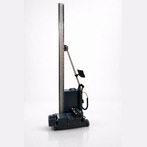
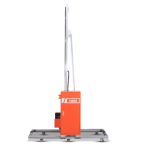
When evaluating a wall printing machine, the ink technology matters as much as the hardware. Two inks dominate the professional wall printing market: UV-curable ink and solvent-based ink. Each has genuine strengths — and each creates real limitations in commercial operation.
This guide provides a complete, technically accurate comparison. If you want the short version: UV ink is the superior choice for professional wall printing in almost every commercial scenario in 2026. Here is the full evidence.
DIRECT ANSWER |
UV ink is better than solvent ink for wall printing in 2026. It cures instantly (no waiting), produces near-zero VOC emissions (safe for occupied spaces), works on a far wider range of surfaces, delivers higher colour vibrancy, and requires less maintenance. |
Solvent ink retains an advantage only in specific outdoor, large-scale, or flexible-media scenarios — none of which are the primary use cases for commercial wall printing. |
Understanding why the two inks perform differently requires understanding how they dry — because the drying mechanism determines almost every other performance characteristic.
Solvent ink uses volatile organic compounds (VOCs) as a carrier liquid for pigments. When applied to a surface, the solvent evaporates into the surrounding air, depositing the pigment on — or slightly into — the substrate. This evaporation process takes time, produces chemical fumes, and requires ventilation. Because the drying relies on air circulation, temperature, and humidity, drying times vary and can create issues with consistency in different environments.
The absorption of solvent ink into porous surfaces can produce strong adhesion on materials like vinyl and canvas. On non-porous surfaces (glass, metal, sealed walls), adhesion can be problematic without primers.
UV ink contains pigments suspended in a monomer and oligomer base, plus a photoinitiator compound. When the UV LED lamps mounted on the print head carriage expose the freshly deposited ink to ultraviolet light at 395–405 nm wavelength, the photoinitiator triggers instant cross-linking of the monomers — forming a solid, dense polymer layer bonded to the surface. This curing happens in milliseconds, before the next pass of the print head begins.
The result: ink that is instantly dry, never absorbed into the surface, and chemically inert after curing — producing no ongoing emissions in the printed space.
Full ink specification details are available on the wall printer ink page.
Performance Dimension | UV Ink | Solvent Ink | Winner |
|---|---|---|---|
Drying time | Instant (milliseconds) | Minutes to hours | UV |
VOC emissions | Near-zero (up to 99.5% VOC-free) | Significant — ventilation required | UV |
Indoor air safety | Excellent — suitable for occupied spaces | Poor — requires evacuation/ventilation | UV |
Colour vibrancy | Excellent — sits on surface, maximum saturation | Good — absorption can dull colours slightly | UV |
Resolution / sharpness | Up to 4,800 DPI | Up to 1,440 DPI (typical) | UV |
Surface compatibility | Extremely wide — glass, metal, stone, ceramic, wood | Narrower — primarily porous/coated media | UV |
Indoor durability | 4–8 years | 3–5 years | UV |
Outdoor durability | 2–3 years (5+ with varnish) | 3–6 years (inherently UV-resistant pigments) | Solvent (outdoor) |
Flexible media (vinyl/fabric) | Requires flexible ink formula | Excellent — standard use case | Solvent |
Ink cost per m² | ~$1.60 (Tudox operations) | $2–$4 | UV |
Print head maintenance | Lower — no solvent evaporation in head | Higher — solvent dries in head nozzles, causing clogs | UV |
Print head clog risk | Low | Higher — regular purging required | UV |
The VOC difference between the two inks is not a minor technical footnote — it has direct commercial implications for professional UV wall printing operators:
The surface compatibility advantage of UV ink is one of the most commercially important differentiators for wall printing operators. For the full surface guide, see: What Surfaces Can a Wall Printer Print On?
Surface Type | UV Ink | Solvent Ink | Notes |
|---|---|---|---|
Smooth plastered wall | Excellent | Good | Both viable; UV sharper |
Painted wall (matt/eggshell) | Excellent | Good | UV preferred for colour accuracy |
Glass (primed) | Excellent | Poor | Solvent has poor adhesion on non-porous surfaces |
Metal (primed) | Excellent | Poor | Same issue — non-porous surface incompatibility |
Ceramic tiles (primed) | Excellent | Poor | UV dominates on hard non-absorbent surfaces |
MDF / composite panels | Excellent | Good | UV produces sharper detail |
Exposed brick / concrete | Good | Good | Both viable with appropriate preparation |
Vinyl / PVC flex | Good (flexible formula) | Excellent | Solvent’s strongest use case |
Fabric / canvas | Moderate (flexible formula) | Excellent | Solvent preferred for fabric |
Floor surfaces | Excellent | Poor | UV critical for commercial floor durability |
For detailed durability data with test results, see our dedicated article: How Long Does Wall Printer Ink Last?
The durability picture is more nuanced than a simple UV > Solvent conclusion. For indoor commercial applications — which represent over 85% of professional wall printing revenue — UV ink is clearly superior in both longevity and colour stability.
For outdoor-primary applications (exterior building murals, uncovered outdoor murals in high-UV climates), solvent ink’s inherent UV-resistance in the pigment carrier gives it an edge at 3–5 years without additional coating. However, a UV print with a UV-blocking varnish topcoat matches or exceeds this outdoor performance — and maintains the VOC, maintenance, and surface compatibility advantages in all other respects.
PRACTICAL CONCLUSION FOR OPERATORS |
If your primary market is commercial interiors — hospitality, offices, retail, residential — UV ink is the definitive choice. No caveats. |
If you specifically target large-scale outdoor murals in full-sun environments as your primary revenue, eco-solvent ink for those specific jobs may supplement UV ink for interior work — but building a wall printing business around solvent ink exclusively makes no commercial sense in 2026. |
The Tudox wall printing machine is engineered for UV ink — and this engineering choice has direct maintenance implications:
Solvent ink’s greatest maintenance challenge is nozzle clogging. When the machine is idle, solvent in the print head nozzles continues to evaporate, leaving dried pigment residue that blocks nozzles and degrades print quality. Regular purging, cleaning cycles, and nozzle checks are essential — adding both direct cost (ink waste during purging) and operational downtime.
UV ink does not evaporate at room temperature. It remains liquid in the print head nozzles until exposed to UV light. This means significantly reduced clogging risk, fewer maintenance cycles, and lower consumable waste. Tudox machines run automated maintenance cycles that take 30–60 seconds — not the 15–30 minute cleaning sessions that solvent operators often require before each day’s work.
Maintenance Factor | UV Ink Machine | Solvent Ink Machine |
|---|---|---|
Daily pre-print maintenance | Automated 30–60 sec cycle | Manual nozzle check + purge: 15–30 min |
Nozzle clog frequency | Low — ink stable at rest | Higher — solvent evaporates in nozzle |
Ink waste in maintenance | Minimal | Significant — purging consumes ink |
After long idle periods | Brief automated cycle | Extensive cleaning — risk of permanent clogs |
Print head lifespan | Extended — no corrosive solvent exposure | Reduced — solvent degrades head components |
Ventilation requirement | None | Required — solvent fumes during operation |
Every Tudox model — the TDX ECO, TDX 3000, and TDX-W — is engineered exclusively for UV-curable ink. This is a deliberate engineering and commercial decision, not a constraint:
The result: a professional machine built for commercial operators who need consistent, high-quality output across the widest possible range of client environments — without the operational compromises that solvent ink introduces.
No. UV and solvent inks require fundamentally different print head designs and curing systems. UV ink requires piezoelectric heads compatible with the ink’s viscosity and photoinitiator chemistry, plus UV LED curing lamps. Installing solvent ink in a UV machine would immediately damage the print head. The two systems are not interchangeable.
Yes. Once cured, UV ink forms a chemically inert, solid polymer layer. It produces no ongoing emissions, has no odour, and is safe in occupied spaces including rooms used by children and vulnerable adults. Uncured UV ink (in the cartridge) should be handled with gloves as with any printing ink, but the printed output carries no safety concerns.
Per litre, premium UV inks cost slightly more than standard solvent inks. However, the operational cost per m² is lower for UV ink: ~$1.60/m² for UV versus $2–$4/m² for solvent, because UV ink requires no solvent carrier liquid, wastes less in maintenance purging, and uses more efficient piezoelectric drop placement. Total operational cost favours UV for most commercial workloads.
The UV vs. solvent debate for commercial wall printing has a clear answer in 2026. For professional operators targeting commercial interiors — which represent the vast majority of the market — UV ink delivers superior performance on every dimension that matters in a client-facing service business: instant curing, zero VOCs, wider surface range, higher vibrancy, lower maintenance, and better indoor durability.
Tudox Machine Limited Company
Manufactures and sells Wall Printing Machine.
Tudox Machine Limited Company
Manufactures and sells Wall Printing Machine.
Talk to our team
Fill out the form and our team will contact you.
[email protected]
+90 542 694 8714
Yeni Mah. Gaziler Cd. No:10 Çayırova/Kocaeli/Turkey

Tudox Wall Printer © 2026. All Rights Reserved.
Design & Development & Digital Marketing by Get Rank Lab
[email protected]
+90 542 694 8714
Yeni Mah. Gaziler Cd. No:10 Çayırova/Kocaeli/Turkey
Tudox Wall Printer © 2026. All Rights Reserved.
Design & Development & Digital Marketing by Get Rank Lab
WhatsApp us
Formu doldurun, istediğiniz ürün veya ürünler için teklif alın.
Fill in the form and get an offer for the product or products you want.