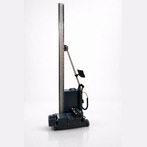
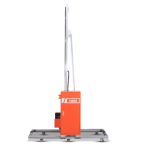
Before spending $11,000 on any piece of equipment, a business-minded person asks a simple question: do the numbers work? This article gives you an honest, evidence-based answer — not marketing copy designed to sell you a machine, but a realistic analysis of the market, the costs, the revenue potential, and the conditions under which a wall printer genuinely makes sense as a business investment.
The short answer is yes — for the right operator, in the right market, with a structured approach. Here is the full case. For the detailed ROI calculation, see our dedicated wall printer ROI calculator.
DIRECT ANSWER |
A wall printer is a strong business investment for entrepreneurs, existing print/design businesses, and commercial operators who can consistently generate 3–4 projects per week. |
At standard commercial pricing ($35–$80/m²), a $11,000 Tudox TDX-W generates gross margins of 95–98% per project and recovers the machine investment in 4–7 weeks. |
It is NOT the right investment if you have no client acquisition plan, no local commercial market, or expect the machine to generate business without active sales effort. |
1. The Market Case: Is There Real Demand?
The global wall printing market is growing at 7.7–9.5% CAGR, projected to reach $3.86–$4.23 billion by 2033. For the full market analysis, see: Wall Printing Industry Trends 2026.
More relevant than global figures is local market reality. Ask three questions about your area:
- Are there restaurants, cafés, hotels, or retail stores with plain, underutilised walls? In virtually every city with a population over 50,000, the answer is yes.
- Is there an established local wall printing operator? In most secondary cities and regional markets, the answer is no — or there is at most one competitor.
- Are commercial business owners in your area paying for interior design? If local hospitality and retail are investing in their spaces, wall printing services will find a market.
The demand exists. The question is whether you can access it — and that depends on your market approach, not on the technology.
2. Who Should (and Should Not) Invest
Strong Candidates for Investment
Profile | Why Wall Printing Works | Expected Payback |
|---|
Entrepreneur in underserved market | First-mover advantage; limited competition; high local demand | 4–8 weeks |
Existing sign / print business | Existing client base; add service line without new infrastructure | 2–4 weeks |
Interior designer / decorator | Integrate printing into design projects; premium service offering | 4–6 weeks |
Painting / decorating contractor | Upgrade from brushwork to high-margin print service | 3–6 weeks |
Marketing / advertising agency | In-house branded environment production; client service expansion | 4–8 weeks |
Situations Where Caution Is Warranted
- No existing network or client relationships in target industries — client acquisition takes 4–8 weeks minimum; plan for this financially
- Very small local market (under 20,000 population) without a clear commercial hub nearby
- Operator not committed to consistent marketing effort — the machine generates no revenue sitting idle
- Primary interest in residential work only — residential projects are viable but have lower project values and longer sales cycles than commercial
3. The Investment Reality: What You Actually Pay
Full model pricing is on the wall printer prices page. The Tudox TDX-W at $11,000 is the all-in professional entry point. No hidden costs, no mandatory consumable contracts, no licensing fees.
Investment Component | Cost | Notes |
|---|
Machine (TDX-W) | $11,000 | Dual wall + floor; industrial-grade print head |
Training | $0 | Included — A-Z operator training |
Software (RIP) | $0 | Included — commercial RIP licence |
Lifetime technical support | $0 | Included — remote diagnostics |
Public liability insurance | $200–$600/yr | Essential for commercial premises work |
Initial marketing materials | $100–$300 | Portfolio photography, social media setup |
Total Year 1 Investment | ~$11,300–$11,900 | Highly predictable; no major hidden costs |
4. Revenue vs. Cost: The Numbers That Matter
At UV ink cost of ~$1.60/m², your material cost is negligible. Your real cost per project is dominated by time — and time is the one resource you control.
Scenario | Projects/Week | Avg Revenue | Weekly Net | Payback Period |
|---|
Cautious start (part-time) | 2 | $800 | ~$1,480 | ~7.4 weeks |
Standard commercial | 4 | $1,100 | ~$4,080 | ~2.7 weeks |
Active full-time | 7 | $1,300 | ~$8,400 | ~1.3 weeks |
Recurring contracts added | 4 + contracts | $1,400 | ~$10,200 (month) | Month 1 recovery |
Note: ‘weekly net’ = gross revenue minus ink, transport, and allocated insurance costs (~12% of revenue). Machine depreciation excluded from weekly net to show operating cash flow; the machine is a capital asset, not a monthly expense.
THE MARGIN THAT MAKES THIS WORK |
Material cost: ~$1.60/m². Service charge: $35–$80/m². Gross margin before labour: 95–98%. |
There are very few service businesses on Earth with this cost structure. The reason wall printing works financially is not mystery — it is pure unit economics. |
5. Realistic Risk Assessment
Risk | Likelihood | Impact | Mitigation |
|---|
Slow first-month client acquisition | Medium — normal for new operators | Moderate — delays payback | Build portfolio before launch; offer introductory pricing |
Machine technical failure | Low — Tudox warranty + support | Low — fast resolution available | Lifetime support included; 2–4 day parts resolution typical |
Local price competition enters | Low in most secondary markets in first 1–2 years | Moderate | Build recurring contracts; quality reputation is sustainable moat |
Ink supply disruption | Very low | Low — 2–3 liter buffer resolves | Maintain stock; Tudox supply chain is reliable |
Client doesn’t pay | Low (B2B commercial) | Moderate per project | 50% deposit on all projects over $500 |
6. How to Maximise the Investment: The Strategic Layer
The operators who recover their investment fastest are not those who take every job — they are those who focus on high-value segments and build recurring relationships. See the full framework: 10 Wall Printing Business Models That Generate Recurring Revenue.
- Target commercial clients first: restaurants, hotels, offices — higher project values, faster decisions, repeat potential
- Build 5–8 portfolio projects in a single vertical before expanding — depth of portfolio in one segment converts better than breadth across many
- Propose seasonal campaign contracts after every one-off project — convert single projects into 4 annual jobs per client
- Build interior designer relationships early — one active designer partner generates 10–20 referrals per year
- Document every project professionally — photography is your single most powerful sales tool
7. Comparison: Wall Printer vs. Other $10K–$15K Business Investments
Business Investment | Entry Cost | Revenue Potential (Y1) | Payback (Typical) | Key Advantage |
|---|
Tudox TDX-W Wall Printer | $11,000 | $100,000–$280,000 | 3–7 weeks | Exceptional unit economics; no inventory |
Commercial cleaning franchise | $15,000–$40,000 | $30,000–$60,000 | 12–24 months | Stable but lower margin |
Mobile catering / food truck | $25,000–$80,000 | $40,000–$90,000 | 18–36 months | High ongoing costs |
Sign / vinyl wrap setup | $15,000–$30,000 | $60,000–$120,000 | 6–12 months | Complementary to wall printing |
Photography studio equipment | $10,000–$20,000 | $40,000–$80,000 | 6–18 months | Market saturation in many areas |
Q: Do I need printing industry experience?
No prior printing experience is required. Tudox includes comprehensive A-Z operator training with every machine purchase — covering technical operation, RIP software, colour management, and the practical business skills needed to run a professional service. Most operators are printing commercially within 1–2 weeks of receiving their machine.
Q: Is the market too saturated to enter in 2026?
In major metropolitan areas (London, New York, Sydney), the market is competitive. In secondary cities and regional markets — which represent the majority of addressable locations globally — meaningful competition is still rare. The market growth rate of 7.7–9.5% CAGR indicates the opportunity is expanding, not contracting.
Q: What if I can only work part-time initially?
The economics work at part-time volume. At 2 projects per week at $800 average, net weekly income is approximately $1,480. Machine payback at this volume: approximately 7–8 weeks. Part-time wall printing is a viable income supplement — and a natural starting point for operators building toward full-time.