Imagine walking into a plain white hotel lobby and, within a few hours, seeing a breathtaking mural printed directly onto the wall — no paint, no vinyl, no waiting. This is exactly what modern wall printing technology makes possible.
Whether you’re an entrepreneur looking for your next business opportunity, an interior designer seeking new tools, or a café owner wanting to transform your space — this guide covers everything you need to know about wall printing in 2026: how it works, what it costs, who uses it, and how to choose the right machine.
2–6 m²/hr | Print speed Most modern commercial wall printers, including Tudox models |
15 minutes | Setup time From unpacking to first print with a Tudox machine |
~$1.60 | Cost per m² Average ink + operational cost with UV wall printing |
60–70 m²/L | Ink coverage With 1 liter of UV ink on standard surfaces |
4–8 years | Indoor durability UV ink prints on interior walls under normal conditions |
From $8,000 | Entry investment Tudox TDX ECO — one of the most affordable professional options |
A wall printing machine — also called a vertical digital printer, wall plotter, or mural printer — is a device designed to print high-resolution images, patterns, logos, or artwork directly onto walls, floors, and other flat surfaces.
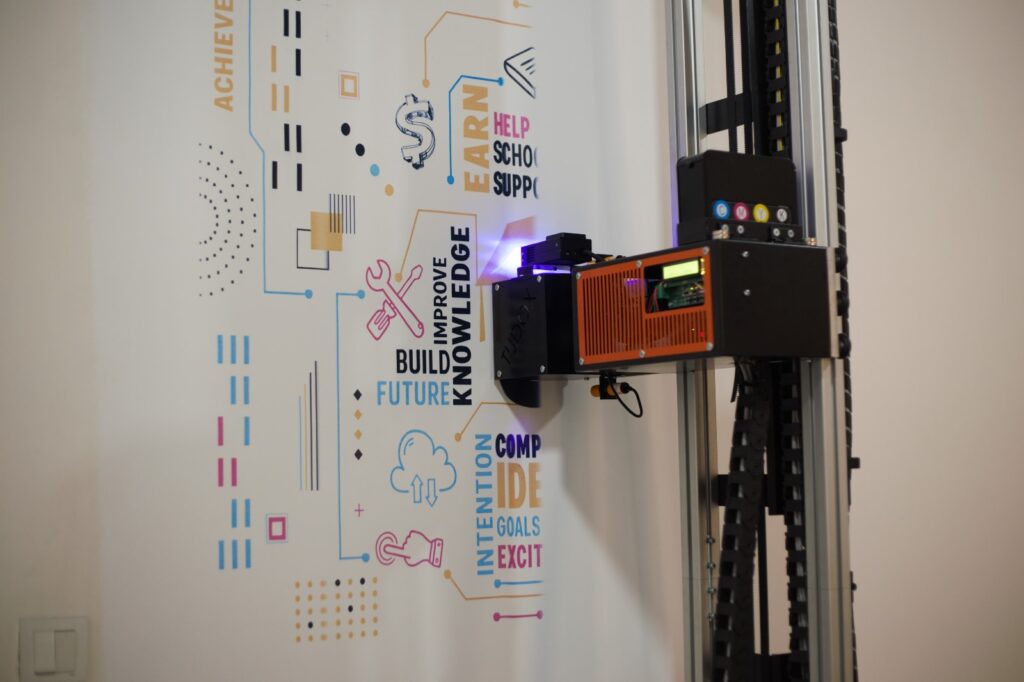
Unlike traditional printing, which applies ink to paper fed through a machine, a wall printer moves vertically along the surface using a motorized rail system. The print head travels across the wall in precise passes, depositing UV-curable ink that dries almost instantly under ultraviolet light.
The result: sharp, full-color, permanent prints on virtually any surface — without any paper, vinyl, or adhesive backing.
Feature | Regular Inkjet Printer | Wall Printing Machine |
|---|---|---|
Print surface | Paper / flat media | Walls, floors, glass, metal, wood, concrete |
Output size | Limited to paper width | Up to 290 cm height × 400 cm+ width |
Ink type | Water-based / dye | UV-curable (instant dry) |
Movement | Paper moves through machine | Machine moves along the wall |
Drying time | Minutes to hours | Seconds (UV curing) |
Use case | Documents, photos | Decoration, branding, murals, advertising |
Imagine walking into a plain white hotel lobby and, within a few hours, seeing a breathtaking mural printed directly onto the wall — no paint, no vinyl, no waiting. This is exactly what modern wall printing technology makes possible.
Whether you’re an entrepreneur looking for your next business opportunity, an interior designer seeking new tools, or a café owner wanting to transform your space — this guide covers everything you need to know about wall printing in 2026: how it works, what it costs, who uses it, and how to choose the right machine.
2–6 m²/hr | Print speed Most modern commercial wall printers, including Tudox models |
15 minutes | Setup time From unpacking to first print with a Tudox machine |
~$1.60 | Cost per m² Average ink + operational cost with UV wall printing |
60–70 m²/L | Ink coverage With 1 liter of UV ink on standard surfaces |
4–8 years | Indoor durability UV ink prints on interior walls under normal conditions |
From $8,000 | Entry investment Tudox TDX ECO — one of the most affordable professional options |
A wall printing machine — also called a vertical digital printer, wall plotter, or mural printer — is a device designed to print high-resolution images, patterns, logos, or artwork directly onto walls, floors, and other flat surfaces.
Unlike traditional printing, which applies ink to paper fed through a machine, a wall printer moves vertically along the surface using a motorized rail system. The print head travels across the wall in precise passes, depositing UV-curable ink that dries almost instantly under ultraviolet light.
The result: sharp, full-color, permanent prints on virtually any surface — without any paper, vinyl, or adhesive backing.
Feature | Regular Inkjet Printer | Wall Printing Machine |
|---|---|---|
Print surface | Paper / flat media | Walls, floors, glass, metal, wood, concrete |
Output size | Limited to paper width | Up to 290 cm height × 400 cm+ width |
Ink type | Water-based / dye | UV-curable (instant dry) |
Movement | Paper moves through machine | Machine moves along the wall |
Drying time | Minutes to hours | Seconds (UV curing) |
Use case | Documents, photos | Decoration, branding, murals, advertising |
The technology behind wall printing is elegant in its simplicity. Here’s how a typical Tudox machine produces a print from start to finish:
You create or import your design on a laptop using standard design software (Adobe Illustrator, Photoshop, CorelDRAW, or even Canva for simpler prints). The software formats the image to match the exact dimensions of your target wall area.
The wall printer is positioned against the wall using its guide rail system. The rail is mounted to the wall with suction cups or temporary brackets — no drilling required. The machine is leveled and calibrated, a process that takes about 15 minutes with a Tudox machine.
The print head is positioned at the correct distance from the surface (typically 1–3 cm). Built-in sensors on premium models automatically detect surface irregularities to maintain consistent ink application across textured or uneven walls.
The machine prints in horizontal passes, moving the print head left and right while the carriage advances downward. UV LEDs behind the print head cure (harden) the ink almost instantly, so each pass is dry before the next begins.
No waiting, no sealing, no laminating required. The print is ready immediately after completion. You can reposition the machine and continue to an adjacent section of wall within minutes.
PRO TIP — Tudox Setup Advantage |
Tudox machines are designed with field operators in mind. The guide rail system reduces alignment errors, and the compact design means even the TDX-W (wall + floor dual-function model) can be transported in a standard vehicle and set up by one person. |
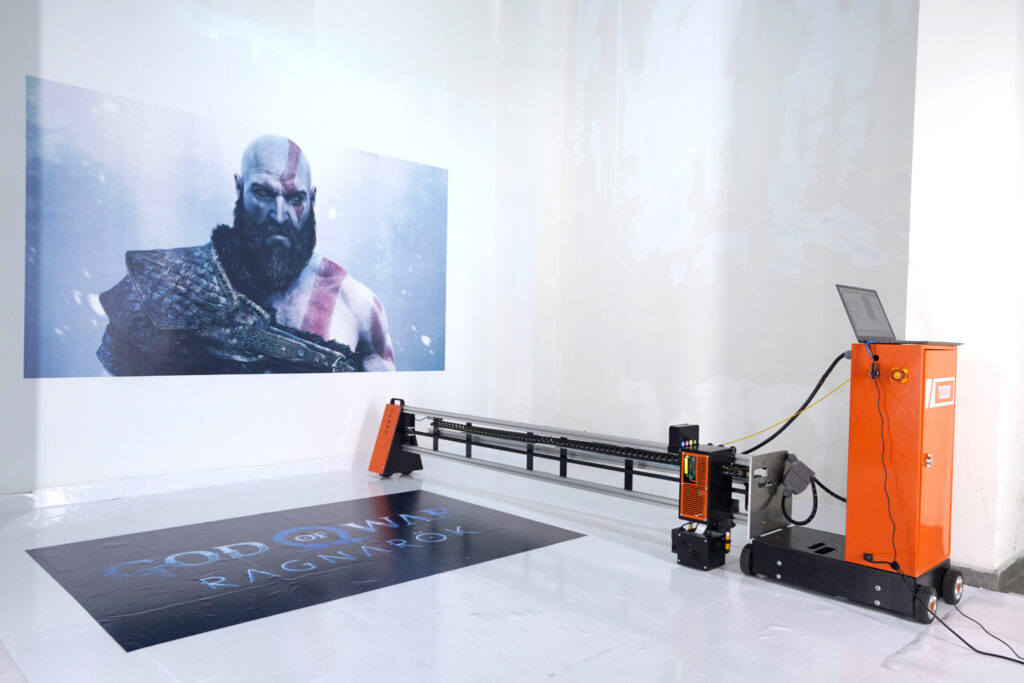
One of the most common questions from beginners: ‘Can it really print on my wall?’ In almost every case, the answer is yes. Wall printers using UV ink technology are remarkably versatile.
Very high-gloss or highly porous surfaces may require a base coat or primer before printing. Surfaces with peeling paint should be repaired first. Extremely dark backgrounds may need a white base layer to ensure color accuracy.
IMPORTANT — Surface Color Matters |
UV ink is semi-transparent. Printing on a white or light surface gives the most accurate, vibrant colors. On dark surfaces, a white underprint layer is recommended. Tudox machines can handle this automatically with a multi-pass setting. |
Not all wall printers use the same ink technology. Tudox machines use UV-curable ink exclusively — and this is a significant advantage over older or cheaper alternatives.
Property | UV Ink (Tudox) | Solvent Ink | Water-Based Ink |
|---|---|---|---|
Drying method | UV light (instant) | Evaporation (slow) | Air dry / heat |
Indoor odor | Minimal | Strong / toxic fumes | Low |
Color vibrancy | Excellent | Good | Moderate |
Durability (indoor) | 4–8 years | 3–5 years | 1–3 years |
Durability (outdoor) | ~2.4 years | 3–6 years (with UV coat) | Poor |
Surface flexibility | Very wide | Moderate | Limited |
Cost per m² | ~$1.60 | $2–4 | $1–2 |
Environmental impact | Low (low VOC) | High (VOCs) | Low |
The market for wall printing spans an enormous range of industries and project types. Here’s where professionals are using this technology in 2026:
Tudox manufactures three main commercial-grade models. Each is designed for a different operational profile:
TDX ECO | TDX 3000 | TDX-W | |
|---|---|---|---|
Max print height | 200 cm | 290 cm | 290 cm (wall) |
Max print width | 400 cm | 400 cm+ | 170 cm (floor) |
Print speed | 2–6 m²/hr | 2–6 m²/hr | 2–6 m²/hr |
Weight | 70 kg | 85 kg | 85 kg |
Dual function | Wall only | Wall only | Wall + Floor |
Approx. price | $8,000 | $9,500 | $11,000 |
Best for | Starter / ECO | High-volume commercial | Versatility champions |
This is the question every aspiring operator asks — and the numbers are compelling.
Scenario | Per Project | Monthly (10 projects) |
|---|---|---|
Restaurant wall mural (20 m²) | $800 – $1,200 | $8,000 – $12,000 |
Office branding wall (30 m²) | $1,200 – $2,000 | $12,000 – $20,000 |
Retail promotional graphics (15 m²) | $600 – $900 | $6,000 – $9,000 |
Hotel lobby feature wall (40 m²) | $1,600 – $2,800 | $16,000 – $28,000 |
Residential bedroom mural (10 m²) | $400 – $700 | $4,000 – $7,000 |
At an average cost of just ~$1.60 per m², your material cost is minimal. The bulk of your revenue is labor, equipment ROI, and your creative expertise.
If you complete just 3 mid-size projects per month at an average of $1,500 revenue each, you generate $4,500/month. At this rate, your machine pays for itself in approximately 2–3 months of consistent operation.
Understanding your real operational costs is critical for accurate pricing. Here’s a full breakdown:
Cost Item | Estimated Cost | Frequency / Notes |
|---|---|---|
UV ink (per liter) | $35–$60 | Covers 60–70 m² per liter |
Electricity | ~$0.05–0.10/hr | UV LED systems are energy-efficient |
Machine maintenance | Low | Guide rail + print head cleaning; no major consumables |
Transport | Variable | Machine is portable; fits in standard vehicle |
Software/design | $0–$50/month | Many open-source and affordable options available |
Training (one-time) | Included | Tudox provides comprehensive A–Z training with purchase |
Total cost per m² | ~$1.60 | Based on ink + energy + amortized maintenance |
Ready to move from curious to committed? Here’s the practical roadmap for first-time buyers:
Learning from others’ mistakes saves you time, money, and client relationships:
Printing on a dirty, glossy, or poorly painted surface degrades print quality significantly. Always clean and inspect the surface before setup. Lightly sand high-gloss finishes.
Tight corners, furniture, and obstructions add time to your setup. Always build extra time into your project estimates for complex environments.
What you see on screen is not always what prints on the wall. Use proper CMYK color profiles and, when possible, print a small test patch before committing to the full design.
Because operational costs are low, many beginners underprice dramatically. Price based on the value of the transformation you deliver — not just material cost. Your expertise, time, and equipment investment all deserve compensation.
Every project is a marketing asset. Document every wall you print with professional photos and a brief project description. This portfolio is your single most powerful sales tool.
Q: Is wall printing permanent?
Yes. UV ink bonds directly to the surface and cures to a hard finish. Indoor prints typically last 4–8 years; outdoor prints around 2–3 years depending on sun and weather exposure.
Q: Can I use a wall printer on outdoor walls?
Yes, with UV-resistant ink formulations. Tudox machines support outdoor printing, though additional protective coatings may extend durability further.
Q: Do I need to be a designer to operate a wall printer?
No. Most operators use existing designs from clients or stock libraries. Tudox provides training that covers the basic design workflow. However, offering design services alongside printing significantly increases your earning potential.
Q: How loud is a wall printer during operation?
Wall printers are relatively quiet — similar in sound level to a standard office printer. They are suitable for use in occupied spaces like offices and hotels during business hours.
Q: Can I print the same design multiple times?
Yes. Once a design file is configured, you can reproduce it exactly across any number of locations. This is particularly valuable for chain retailers and hotel groups with multiple properties.
Q: What if the machine breaks down?
Tudox provides technical support to all customers. The team is available to assist with troubleshooting remotely, and parts can be shipped internationally for repairs.
Q: How portable is the machine?
Very. All Tudox models are designed to be disassembled for transport and fit comfortably in a standard cargo van or large car. Assembly takes approximately 15 minutes on-site.
Wall printing is one of the most versatile and profitable niches in the digital printing industry. Whether you’re looking to add a high-value service to your existing design or construction business, launch a standalone wall printing operation, or transform spaces for clients who demand something extraordinary — the technology is mature, accessible, and proven.
The barrier to entry has never been lower. With machines starting at $8,000, operational costs around $1.60/m², and a setup time of just 15 minutes, a single project can deliver meaningful returns on investment within weeks.
The question isn’t whether wall printing is a good business — the question is whether you’re ready to be the one doing it in your market.
Tudox Machine Limited Company
Manufactures and sells Wall Printing Machine.
Tudox Machine Limited Company
Manufactures and sells Wall Printing Machine.
Talk to our team
Fill out the form and our team will contact you.
[email protected]
+90 542 694 8714
Yeni Mah. Gaziler Cd. No:10 Çayırova/Kocaeli/Turkey

Tudox Wall Printer © 2026. All Rights Reserved.
Design & Development & Digital Marketing by Get Rank Lab
[email protected]
+90 542 694 8714
Yeni Mah. Gaziler Cd. No:10 Çayırova/Kocaeli/Turkey
Tudox Wall Printer © 2026. All Rights Reserved.
Design & Development & Digital Marketing by Get Rank Lab
WhatsApp us
Formu doldurun, istediğiniz ürün veya ürünler için teklif alın.
Fill in the form and get an offer for the product or products you want.