One of the most common questions from first-time buyers is simple: can it actually print on my wall? The short answer is almost certainly yes. But the complete answer — covering which surfaces work best, which require preparation, and which have genuine limitations — is what determines whether a project succeeds or disappoints.
This guide covers every major surface type compatible with UV wall printing technology, including real-world performance data, surface preparation requirements, and practical operator tips for each category.
DIRECT ANSWER |
UV wall printers can print on plastered walls, painted surfaces, wood, glass, metal, concrete, brick, ceramic tiles, stone, wallpaper, MDF, plastic cladding, and most floor surfaces. Approximately 95% of commercial interior surfaces are compatible without special preparation. |
Surfaces requiring preparation (primer, cleaning, or base coat): glass, polished metal, very dark walls, and extremely porous materials. |
Unlike traditional paint or water-based inks, UV-curable ink does not need to be absorbed into a surface to adhere. Instead, it sits on top of the surface and is polymerised — chemically hardened — by ultraviolet LED lamps mounted on the print head carriage. This curing process creates a solid, scratch-resistant layer bonded to the surface.
This physics explains why UV wall printing works on such a diverse range of materials: absorption is irrelevant. The key variable is surface energy — a measure of how well a surface attracts and holds the cured ink layer. Surfaces with higher surface energy provide stronger adhesion; very low-energy surfaces (like some plastics) may require a primer to create the necessary bond.
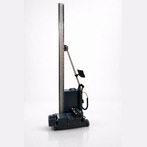
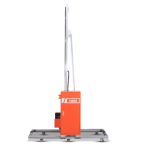
The Tudox wall printing machine‘s ultrasonic distance sensor continuously monitors the gap between print head and surface during printing, automatically adjusting for minor surface irregularities to maintain consistent ink placement across all surface types.
These surfaces work immediately without any preparation beyond basic cleaning. They represent the vast majority of commercial and residential interior printing scenarios.
The ideal surface for UV wall printing. Standard interior plaster — whether bare or painted with emulsion — provides consistent surface energy, minimal texture variation, and excellent ink adhesion. Print quality on smooth plastered walls consistently achieves the highest resolution and colour accuracy of any surface type.
Performance: Excellent. Durability: 4–8 years indoor. Preparation: None (ensure surface is clean and dry).
Painted walls are the most common commercial wall printing substrate globally. Most modern interior paints are fully compatible with UV ink. Matt and eggshell finishes are preferred — they provide a slightly absorbent key that improves ink adhesion compared to very high-gloss finishes.
Performance: Excellent. Durability: 4–8 years. Preparation: Clean surface; lightly sand very glossy finishes.
Factory-primed MDF and sealed plywood print exceptionally well. The uniform, smooth surface produces sharp detail reproduction. MDF is particularly popular for retail display walls, exhibition panels, and commercial interior fit-outs that are printed before installation.
Performance: Excellent. Preparation: Ensure factory primer or sealer is applied; raw MDF is porous and requires sealing first.
Aluminium composite panels (ACP), PVC wall cladding, and similar composite materials are widely used in commercial interiors and retail environments. UV ink bonds directly to these non-porous surfaces without preparation. Print longevity on composite panels often exceeds that on painted plaster.
Performance: Excellent. Preparation: Clean with IPA (isopropyl alcohol) to remove surface oils.
Most standard wallpapers — including vinyl-coated and paper-backed varieties — are compatible with UV wall printing. The key requirement is that the wallpaper must be firmly adhered to the wall with no bubbles or loose edges. Textured wallpapers print well but may show slight texture in the final image.
Performance: Good to Excellent. Preparation: Ensure all edges are secure; allow newly applied wallpaper 24–48 hours to fully dry before printing.
These surfaces require one additional preparation step before printing. The extra effort adds 30–60 minutes to project time but results in commercially excellent output.
Glass is printable with UV ink but requires an adhesion primer applied before printing. Without primer, ink may initially appear to adhere but can be scratched off with normal handling. The UV digital wall printing machine‘s white ink channel enables printing on clear or tinted glass with full opacity.
Performance: Excellent (with primer). Preparation: Clean thoroughly with IPA; apply UV glass primer and allow to cure (typically 30 minutes) before printing.
UV ink is semi-transparent. Printing full-colour designs onto dark backgrounds — navy, charcoal, deep green, black — without a base coat results in colour inaccuracy, because the dark background shows through the ink. The solution: print a white base layer first, then print the design on top.
This multi-pass approach effectively doubles print time for the base coat phase but produces vibrant, accurate colours on any background. The white ink channel is standard on all Tudox models.
Performance: Excellent (with white base). Preparation: White underprint layer printed first.
Textured surfaces print well but require specific settings adjustments. The ultrasonic distance sensor compensates for surface variation, but very deep textures (rough stone, rustic brick with deep mortar lines) may require slightly reduced resolution settings to prevent ink from falling into recesses rather than landing on the surface peaks.
Performance: Good. Print speed may reduce by 20–30% on very rough surfaces. Preparation: Remove loose dust; seal very porous surfaces with a thin primer coat for improved adhesion and colour accuracy.
Polished metal surfaces have very low surface energy and require an adhesion primer for reliable UV ink bonding. Once primed correctly, UV prints on metal are exceptionally durable — highly resistant to moisture, cleaning chemicals, and mechanical wear.
Performance: Excellent (with primer). Preparation: Degrease with IPA; apply metal adhesion primer; allow full cure before printing.
Glazed ceramic tiles require the same primer treatment as glass — the smooth, non-porous glaze surface prevents direct adhesion without preparation. Unglazed or matte-finish tiles often print directly without primer. Popular application: restaurant kitchen feature walls, café tile murals, bathroom accent panels.
Performance: Excellent (with primer on glazed tiles). Preparation: Clean with IPA; apply glass/tile primer for glazed surfaces.
These surfaces are printable but require specialist inks, primers, or technique adjustments that go beyond standard commercial practice.
Stone surfaces vary enormously in porosity. Polished marble and granite print similarly to polished metal — an adhesion primer is needed. Rough slate and textured stone present challenges similar to exposed brick. Results are achievable and visually striking but require experienced operator technique.
Raw, unsealed wood is highly porous and will absorb UV ink unevenly, resulting in colour inconsistency. Sealed, painted, or factory-primed wood is in Tier 1. Raw wood should be sealed with a compatible primer before printing. Oiled or waxed wood surfaces are incompatible without full de-oiling and repriming.
Fabric-covered acoustic panels and upholstered wall panels are printable on tight, smooth weave fabrics using flexible UV ink formulations. Standard UV ink (hard formula) may crack on fabric that flexes. This is an advanced application requiring test prints on a sample piece before committing to a full project.
With the Tudox TDX-W wall and floor printing machine, operators can print on floor surfaces as well as walls. The machine switches between wall and floor modes in approximately 5 minutes. Compatible floor surfaces include:
Floor Surface | Compatibility | Preparation | Typical Application |
|---|---|---|---|
Concrete (sealed) | Excellent | Clean; seal raw concrete | Warehouse graphics, retail floors |
Ceramic/porcelain tiles | Good-Excellent | IPA clean; primer for high-gloss | Retail entrance, hotel lobby |
Epoxy-coated floors | Excellent | Degrease; light abrasion | Factory safety markings, events |
Vinyl / LVT | Good | IPA clean | Retail seasonal campaigns |
Natural stone (polished) | Good (with primer) | Adhesion primer required | Hotel lobbies, premium retail |
Raw/unsealed concrete | Moderate | Seal first with compatible primer | Outdoor events, temporary graphics |
For dedicated floor printing projects, see our floor printer page for full technical specifications.
The TDX-W‘s CMYK + White + Varnish ink channels provide specific advantages on surfaces that would challenge single-channel machines:
Not every surface is suitable. For full details on ink properties and compatibility, see our wall printer ink guide.
Surface | Direct Print? | Prep Required? | Durability (Indoor) | Commercial Rating |
|---|---|---|---|---|
Smooth plastered wall | Yes | No | 4–8 years | ★★★★★ |
Painted wall (matt/eggshell) | Yes | Clean only | 4–8 years | ★★★★★ |
MDF (primed) | Yes | No | 5–8 years | ★★★★★ |
PVC / ACP composite | Yes | IPA clean | 5–10 years | ★★★★★ |
Standard wallpaper | Yes | Ensure adhesion | 3–5 years | ★★★★☆ |
Exposed brick (smooth) | Yes | Dust removal | 3–6 years | ★★★★☆ |
Glass | No | Primer required | 4–7 years | ★★★★☆ |
Dark walls | Yes | White base coat | 4–8 years | ★★★★☆ |
Ceramic tiles (glazed) | No | Primer required | 5–8 years | ★★★★☆ |
Polished metal | No | Primer required | 5–10 years | ★★★★☆ |
Raw concrete | No | Seal first | 3–5 years | ★★★☆☆ |
Natural stone | No | Primer required | 4–7 years | ★★★☆☆ |
Raw/unsealed wood | No | Seal first | 3–5 years | ★★★☆☆ |
There is no strict minimum. The ultrasonic distance sensor automatically compensates for surface variation up to approximately 10–15mm. Surfaces rougher than this require reduced resolution settings. For most commercial interiors — plastered walls, painted surfaces, composite panels — no smoothness concern applies.
Yes, provided the wallpaper is fully adhered with no bubbles, tears, or loose edges. The UV print goes directly over the wallpaper pattern — on lighter wallpapers, the existing pattern may show through slightly. On white or very light wallpaper, results are excellent.
No. Tudox machines can print on surfaces that are slightly angled — up to approximately 15° from vertical — by adjusting the rail mounting position. For horizontal floor printing, the TDX-W switches to floor mode with a dedicated horizontal configuration.
Yes. UV ink provides approximately 2–3 years of outdoor durability without protective coating. With a UV-resistant clear varnish topcoat applied after printing, outdoor durability increases to 4–5 years. Ensure the wall surface is weather-stable and not subject to water penetration before printing.
Tudox Machine Limited Company
Manufactures and sells Wall Printing Machine.
Tudox Machine Limited Company
Manufactures and sells Wall Printing Machine.
Talk to our team
Fill out the form and our team will contact you.
[email protected]
+90 542 694 8714
Yeni Mah. Gaziler Cd. No:10 Çayırova/Kocaeli/Turkey

Tudox Wall Printer © 2026. All Rights Reserved.
Design & Development & Digital Marketing by Get Rank Lab
[email protected]
+90 542 694 8714
Yeni Mah. Gaziler Cd. No:10 Çayırova/Kocaeli/Turkey
Tudox Wall Printer © 2026. All Rights Reserved.
Design & Development & Digital Marketing by Get Rank Lab
WhatsApp us
Formu doldurun, istediğiniz ürün veya ürünler için teklif alın.
Fill in the form and get an offer for the product or products you want.